AI investment is rising. Meaningful business impact is not keeping pace.
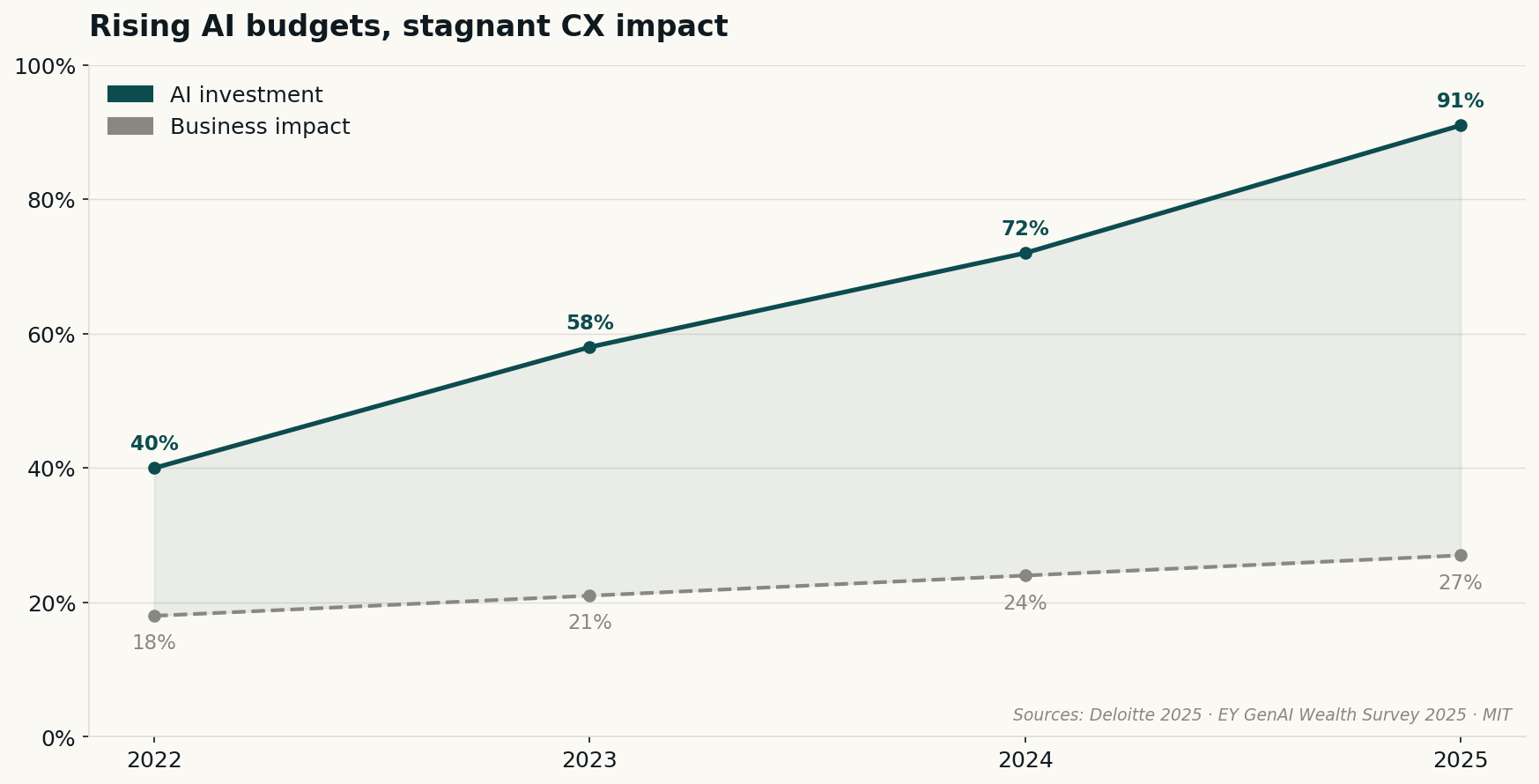
The numbers are striking. According to Deloitte's 2025 survey of 1,854 executives across Europe and the Middle East, 85% of organisations increased their AI investment in the past twelve months, and 91% plan to increase it again. Yet most of those same organisations struggle to point to meaningful business impact — not just financial returns, but the upstream metrics that precede them: customer engagement, NPS, loyalty, and the quality of the relationship with the end customer.
A widely cited MIT study found that 95% of generative AI projects across industries failed to deliver meaningful results. And in CX specifically, CallMiner's 2025 CX Landscape Report found that 62% of leaders admit they rarely use CX data to its best advantage — and 98% report difficulties aligning that data across departments.
Budgets are growing. Impact is not keeping pace. Something is structurally wrong.
The standard explanations miss the point
When analysts explain the impact gap, they tend to point to familiar culprits: fragmented data infrastructure, poor change management, unrealistic timelines, pilots that never reach production. These are real. But they describe symptoms, not causes.
The deeper problem is that most AI deployments in customer-facing contexts are operating without adequate understanding of the customer. They have data — transaction logs, click streams, product usage metrics — but data about what customers do is not the same as understanding who customers are and why they behave the way they do.
A personalisation engine trained on purchase history can predict the next likely purchase. It cannot predict how a customer feels, what is driving an unusual behaviour pattern, or whether a recommendation will feel relevant or intrusive. That distinction is the difference between an interaction that builds loyalty and one that gets ignored — or worse, that erodes trust.
As one executive told Deloitte researchers: "Everyone is asking their organisation to adopt AI, even if they don't know what the output is. There is so much hype that I think companies are expecting it to just magically solve everything."
More AI on top of weak foundations
The irony is that as agentic AI moves from concept to pilot, the stakes of this problem are increasing. Agents that act autonomously on behalf of customers — rebalancing portfolios, adjusting consumption plans, recommending products — are only as good as the context they operate with. And context built entirely on transactional signals is thin.
Deploying more sophisticated AI on top of the same weak customer understanding does not close the impact gap. It widens it. The agent becomes faster and more autonomous — but it is still operating without knowing who it is actually serving.
What meaningful impact actually requires
The banking and wealth management sector illustrates the gap precisely. EY's 2025 GenAI survey found that 95% of wealth and asset managers have scaled GenAI to multiple use cases — yet only one in four reported substantial business impact. The technology is deployed. The understanding of the client is not.
Business impact in CX — engagement that sticks, NPS that moves, loyalty that compounds into revenue over time — follows from one thing: customers feeling genuinely understood. Not processed. Not targeted. Understood.
That requires closing the gap between behavioural data and genuine customer mindset. It means collecting not just what customers do, but what they think and feel at the moment they do it — through natural, low-friction interactions that fit into existing channels like push notifications, WhatsApp or RCS. It means building a layer of customer context that compounds over time, and that gives AI models the input they need to act well rather than just act fast.
The impact gap is not a technology problem. The technology is capable. It is a context problem. And context is something that has to be deliberately built — through the right channels, the right interactions, and the right strategy for turning micro-signals into meaningful customer intelligence.
Organisations that build this foundation first will find that their AI investments start producing something their current deployments are not: customers who feel known, and act accordingly.